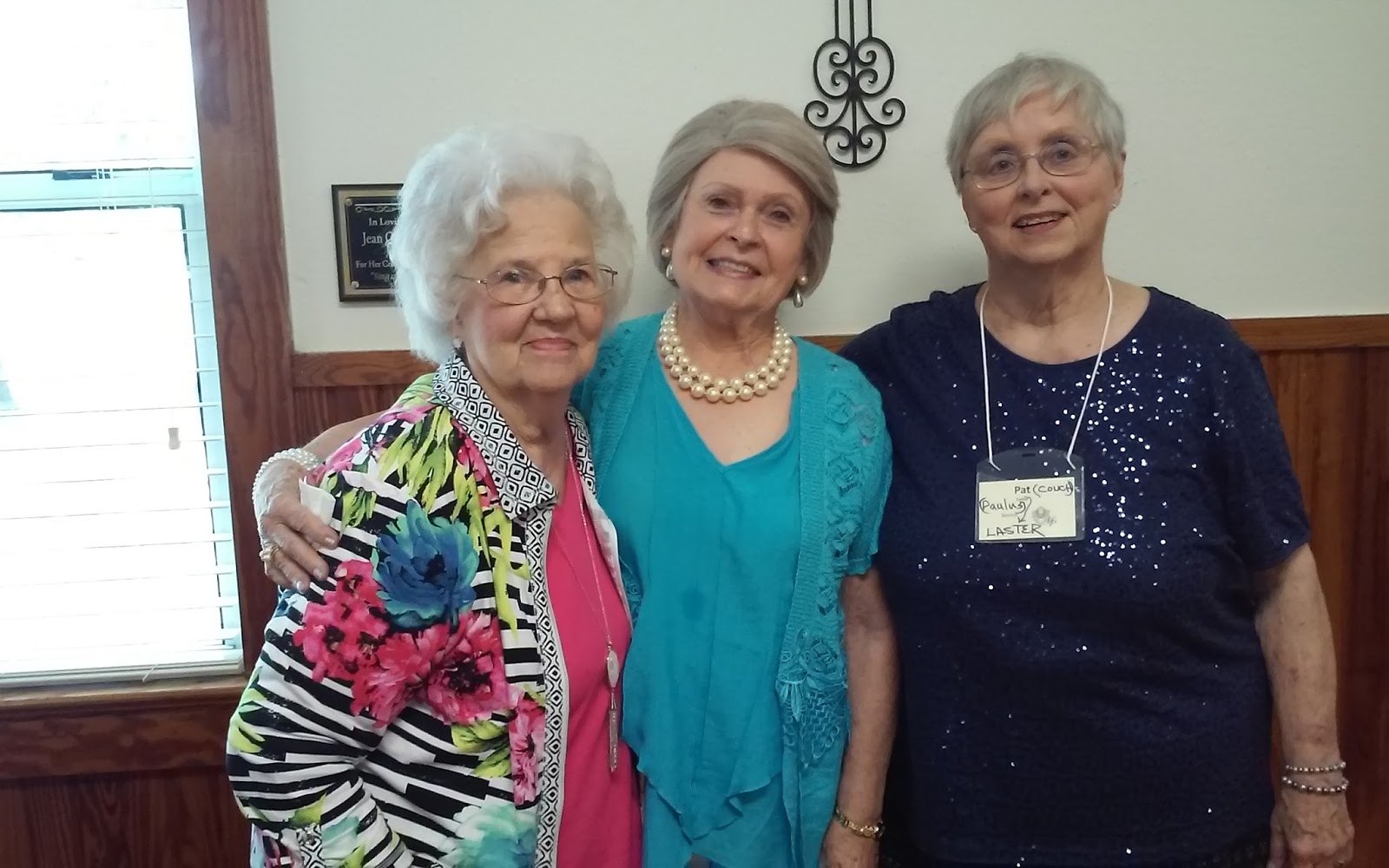
Sunday, June 18, 2017

June is proving to be as busy as May


                At two-o’clock Friday last, my schedule finally cleared. Now I could leisurely read the daily papers that had piled up. I could check blog stats, Facebook, online news-and-opinion as long as I wanted to.
                Keeping me from that retirement ritual was not anything I couldn’t control, but things happened in an odd confluence of events and time. First, was a week’s writers retreat at Hemingway-Pfeiffer Museum in Piggott. Then Florida son flew up for the weekend. The extensive, quarterly Calliope poetry column was due. Finally, I was to host the local writers group on Friday last.
                In this case, the hostess gives the guests gifts; those were bought earlier: a flower-motifed clip, a box of Vanilla Honey tea bags and a gel pen, fine point.
The hostess must clean the areas that writers access: living room, from entry through the room, dining room floor and path to the bathroom, plus said bathroom. The work area—the dining room table—must be redressed. The correct-sized table cloth scrounged for, from either the buffet or the linen closet.
                I don’t think I’d be called a slob, but cleaning for company is about the only time I bother. With only the cat as “family” I DO make sure his area is cleaned enough to keep down the odor.
                Our group schedule is to snack first since it’s a mid-morning meeting. I determined in a Facebook conversation with Linda Ann Yarberry Bragg to use my “good” dishes from now on, so I pulled out snack plates and cups, large and small matching bowls to center the two partitioned platters—all in the Dewdrop pattern. Oh, and we had tea.
                At Harvest Foods on Thursday, I’d filled bag after bag with fruit: 4 plums,4 peaches, 2 grapefruit, 4 nectarines, a container of strawberries and 4 Kiwi. At the cheese display, I selected Cheddar cuts, Colby cuts, Provolone, and Muenster slices. I searched for gluten-free crackers, to no avail, but in passing, I spied a package of Simply White Cheddar Cheetos. It was mine! On the back side of the sack, clear down to the last line was: GLUTEN FREE. Hallelujah!
                We got down to the meat of the day: critiquing previously-submitted pieces. Mine was a new incident for the memoir, which I devised at the H-P retreat earlier in the month. Another was Chapter 7 in a novel. A third was a 10-year look-back on the anniversary of the moon landing, and a fourth was a blog post from an earlier time. It was 12:30 when we finished commenting and praising and asking for more.
                We adjourned to Tacos for Life for our meal. Noisy! Full! A queue! But we all enjoyed our selections. Two of us took boxes of uneaten (too much!) food home for later.
                Serendipitously, we were offered a week’s getaway in July, so our next assignment will be due then.
                One member commented, “Why is it so hard to write when you have so much fun doing it?”

Tuesday, June 13, 2017

Serenaded through the night by trains, writing retreat more than worth it

Bottom Left: Myra & C. D.
Center: Karen & Pat with the piece of blue glass Karen gave Pat for her blue room.
Right: Betsy


  Debbie & Fay


             Debbie & Patricia

Another writing retreat at the Hemingway-Pfeiffer Museum Educational Center in Piggott, Clay County, Arkansas, is history. Attended by fourteen writers from Sarasota, Florida, West Plains, Missouri, Jonesboro, Blytheville, Hot Springs Village, Beebe, Benton, and areas around the host town.

One of my children asked me the difference between Piggott and Eureka Springs—not in geographical terms, but in the writing venues each offers and to which I attend once or twice each year.

Let me digress and address this question: At Eureka Springs’ Writers Colony at Dairy Hollow, writers are assigned an in-house suite for the length of their stay. From the point of moving in, you (the writer) are like a roomer: free to do your own things on your own schedule. The only common time with other residents is weekday evenings at six for on-site prepared meals by the Colony staff.

At the HP retreat, you secure your own lodging. Several of us stay at The Inn in Piggott, formerly the Downtown Inn. It provides breakfast, plus a common fridge and microwave. At least three drove from Jonesboro each day.

The daily schedule begins at nine with two hours of mentor-provided ideas and discussions. C. D. Albin, professor at Missouri State University in West Plains, served as this year’s mentor.

At eleven o’clock each day, the mentor begins 15-minute segments of one-on-one in a quiet back office, while some fan out to other writing spots around the grounds and buildings, or stay in the conference room. I stayed in the big room each day and was pleased that there was not one writer who talked loudly, or coughed constantly.

Lunch was served by the staff at noon, and we ate around the “big” table. Visiting happened here. At one p.m., we had another hour of private writing time and/ or mentor moments. The final hour each day was a sharing of our work; a read-around. Those who asked for comments after their readings got them.

Dinner (or supper) was on our own. Several went to the various eateries in the town, but I “ate in,” having brought food from home. Most days, I could manage a nap before supper. Then I would catch up on the computer news, emails, Facebook, etc. After that, I hit the books, uh, assignments.

The first day dealt with “conflict, crisis, resolution.” Luckily, I was at just such a place in the memoir I’m working on where I remembered an event that showed this assignment perfectly.

Next, “dialogue” in all its various possibilities. Not only words, but body language, tone, silences, even arrangement of words. I began such a scene to appear near the end of said memoir.

“Setting” was the next subject. It can be more than physical. It can be our emotional terrain. An idea came: Write about the house (Couchwood) from the viewpoint of the three generations who have lived here thus far.

Thursday’s subject was “Creative Non-Fiction” with examples of titles and authors.

 Friday, the mentor talked about “Poetry” and poets. “Writing poetry hones your fiction writing,” Dr. Albin said. I can attest to that.

Another week of inspiration, nudges to keep on the task you’ve begun, and good memories. I’m already signed up for the fall retreat and made reservations at the Inn.

Now, to put all these learnings and inspirations into play from day to day.

c 2017 by PL dba lovepat press

Sunday, June 4, 2017

Old Folks Singing at Ebenezer


Folks parked on nearly every grassy spot on three sides of the church.

Good times just kept on rolling by during last month--May. Earlier, the mission trip to south Louisiana, and then Mother’s Day. A week later was my first attendance and participation in Old Folks Singing in Tull, a small town just over the Grant County line (from Saline County) on Highway 190.
                 Hosted by Ebenezer United Methodist Church, this year’s event,was the 132nd such meeting. The small sanctuary was full of folks of all ages—from two to . . . 92(?)
Karen Westbrook, Mark Gillis (standing)
Joan Burton and Jeanette Coppock
             Surnames of officers and planning committees included DuVall, Tull, Westbrook, Burrow, Burton, Parson, Gillis, Jones, Reed, Kiernan, Shults, Smith, Harrison, McDade, Davis, and Greer. Four states were represented.
The weather couldn’t have been better. The church sits on a hill and is surrounded by acres of grassy spaces and trees. A cemetery adjoins the grounds and many families decorated their loved one’s graves with fresh flowers for the occasion.
I parked in my usual place near the front of the building. The minister and his son, the mayor and his wife, and someone in a vehicle out by the cemetery were already there. I carted my TV tray, lawn chair, and tote with drinks, dinnerware, and a large container of frozen pears out to the back area where tables that stretched from here to there were set up.
Leaning the tray and chair against a tree, I took my “potluck” dish to the near end of the long table. From that time until lunch, the fruit would thaw nicely.
By 9:45 a.m. the grassy areas were covered with vehicles. Folks were staking out eating places with card tables and folding chairs and adding their food to the growing board.
At 10 o’clock, the meeting began, greetings and invocation were given, then the singing began. Hardback copies of the 1800s-era “Christian Harmony,” that of shaped notes, open score, myriad repeat signs, dark bar lines and tiny words. Oh, I could hardly keep up on the songs I didn’t know. I eschewed playing any of them even though some kind soul had transcribed an accompaniment booklet.
Different folks—some with family members beside them—selected and “led” the hymns. A  “special” or two, usually grandchildren, paused the group singing. At 11:45, the group broke for “dinner on the grounds,” after a blessing by the acting chaplain, newly-retired Dr. Russell Burton.
By the time I’d visited a spell, gotten my tote from the car, and walked to the back area, groups were heading toward their picnic places. My stuff was in the area where Bob and Bruce Carlisle and their wives had gathered. I asked to join them and they welcomed me. Bruce went through my music classes in Bauxite during the mid-60s."
Toward 1: 15, folks began folding up and preparing to re-enter the church for the afternoon session of a memorial service, then singing from the Cokesbury Worship Hymnal. Now, those I COULD play; they were ones I’d practiced playing in my early piano-lesson days.
Evelyn (Gillis) Kiernan, Shirley (Duvall) Burleson, and moi (pianist at Ebenezer). Janie Wilmoth, a long-time pianist, was ill, and was sorely missed.
We three pianists took turns accompanying, and leaders of each song were summoned from the congregation, some saying they were not aware of this “honor” beforehand. But each—some with memories of forebears’ favorite songs—acted with love and dignity and—at times, laughter.
"Peace, Be Still" sung by (from left) Brian Tull, Rick Burrow and Wilson Duvall
Altogether, around fifty hymns were sung, only the first and last verses of most, according to the emcee. And we all raised voices lustily on each one. After the benediction, we visited again, then departed for our homes.
Now, to wait for the 133rd Old Folks Singing, always the third Sunday in May. Same place. Come!


Tuesday, May 16, 2017

Let the good times roll: a mission trip

One view inside the massive warehouse-depot at UMCOR in Baldwin, Louisiana
              I own a new shirt, a tie-dyed one that says, on the front, Laissez les bon temps rouler. On the back is the phrase in English: “Let the good times roll. / UMCOR Sager Brown/ Baldwin, Louisiana/ www.sagerbrown.com” Down in the Cajun country of south Louisiana, and elsewhere, I suppose, the phrase is pronounced, according to the first entry in the online list, “lay-zEh leh bAwn taw rOO-leh(y).”
                And, indeed, the good times roll when teams work in the football field-sized warehouse/ depot where relief supplies roll in from United Methodist churches nationwide. Regional collection points collect items, box them up, shrink wrap them and ship to Baldwin, LA.

                At the Depot in Baldwin, volunteers, who pay room and board to spend a week in residence, unpack the boxes, go through each bag—school bags, health kits, flood buckets, layette kits, bedding kits—verifying the sent items—required by the New York office—then repacked, boxed, and stacked for shipping wherever the request for relief comes from.
                During our week, 200,000 health kits were requested by Missouri. And before we left, a call had come in for 2,000 more for Northeast Arkansas’s flood victims.
                Of the 47 volunteers last week, several worked on building a ramp for a home in Baldwin. Others walked or rode from the dorms to the Depot where we disassembled and reassembled health kits and school bags.
Gary and Cindy checking school bags for verification
My table emptied school bags, changed out unusable items, replaced them with acceptable ones, and repacked them. From our baskets, they were taken to a long table, counted, placed in cardboard boxes, then stacked on a pallet. When the pallet was full, the new, young forklift fellow transported them to the shrink-wrapping area where they were labeled and wrapped. The boxes were eventually stored in metal shelves to wait for requests.
Friendships were begun at the tables. Folks from other states—Tennessee, Alabama, Texas and Oklahoma and Arkansas—mingled. And if only your team members were working at the same table, you became better acquainted with them. I was an “adoptee” of the Jacksonville group, so I had a chance to learn more about team members. The attitude was playful, the subjects personal but universal, and opinions varied.
Meals—three a day—were other opportunities to meet new folks. Our team had twelve, and the round tables sat only eight, so some of us were forced to find another spot with other teams. That made the camaraderie of newly-made acquaintances a high point of the week. Name tags helped in remembering what face went with what name.
After-hours activities included team devotionals, jigsaw puzzle building, catching up on email and computer, playing games in the activity room. I went back to the dorm and pulled my computer out and checked blog stats and email. Of all the reading materials I took, I didn’t open even one. I only worked on last Sunday’s BIG puzzle.
Wednesday about 11:30, we were rushed from the Depot up to the main buildings: a tornado warning alarm rang and Freddy, the Depot manager, who used to be the forklift driver, hurried us out. At the cafeteria, a higher-up staff member told us a tornado touched down four miles away, and that the Depot would be closed during the afternoon. Of course, I took a long nap—my first and only of the week.
Thursday, the weather cleared off, so our work in the Depot continued. That night was the weekly Vesper Communion service. I was happy to play the electric piano during that memorable event.
Friday morning after breakfast, all teams packed cars, vans, SUVs for the long trips home. Hugs were rampant. “Maybe we’ll meet here again,” was said and heard everywhere.
After arriving home Friday evening, I went to bed early and would have slept around the clock had it not been for Greye meowing incessantly at the hall door at eight a.m.
But I’ll go again if anyone asks me to.
 c  2017 - PL dba lovepat press
               

Monday, April 17, 2017

Three writers together; what might they do? Play a game!

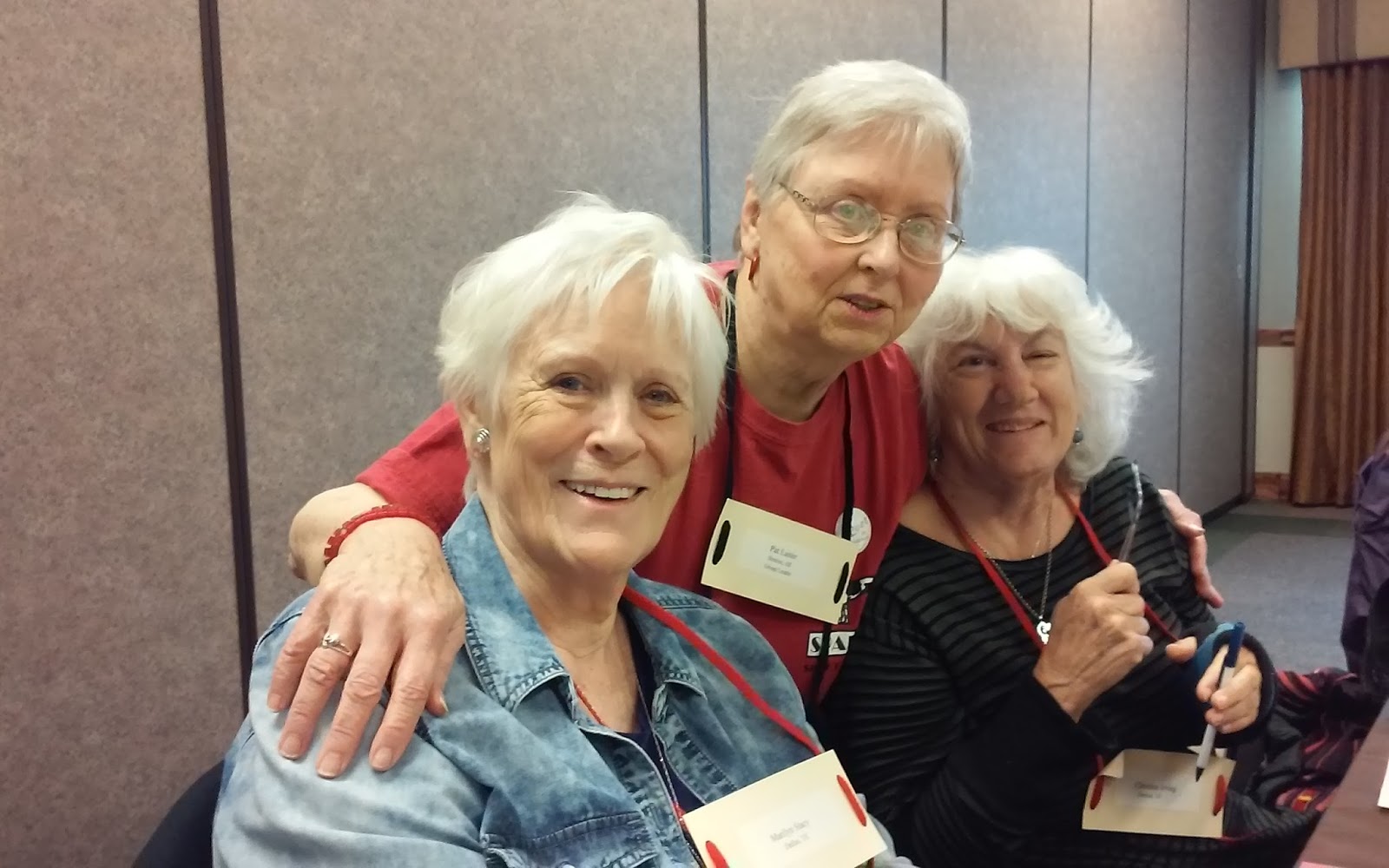
Marilyn, me and Christine - at the Lucidity Poetry Retreat, 2017
~ ~ ~ ~ ~ ~ ~ ~ ~ ~ ~ ~ ~ ~ ~ ~


                Early in April, three women were in residency at Dairy Hollow in Eureka Springs. Lee, from NOLA, Kay from Tulsa/New York, and Pat from AR. All three of us were working on memoirs. [They are not the women in the picture, except for me.]
                At 9:30, the night before two of us left for home, we gathered in the 505 kitchen. Kay brought a novel with her. “For a game,” she said. She and I drank wine; Lee had dessert: banana cream—a sliced banana (and a little sugar) covered by fat-free Pet Milk. I couldn’t—and still can’t—imagine anything with Pet Milk in it as tasting good.
                We “gamed” while we visited. Here are the rules: One writer picks a sentence or two from a novel, writes it on a lined sheet. Then she passes it to the next, who reads it (silently) and writes something that continues the first. But before passing it to the third writer, she folds down the first sentence so that only the second sentence is visible.
                The third writer reads the second sentence, then writes a response to that, folds it so that only her response shows and passes it on. Around and round it goes until the page is full. Here is the complete “story.”
                “Beth puts a finger to his lips. He stops talking. / “Don’t say it. I can’t hear it now. Let me have this moment of not knowing. This one moment.” / “Okay, I’ve settled down enough to respond to your accusations. But be nicer. Don’t forget to give yourself the feelings and not blame me.”
                “Oh, you narcissist! I come to you with my pain, and all you can do is say ‘Don’t blame me’!” / “That is not what I said. It’s complicated, don’t you get that?” / “No, it’s not. It’s simple. You simply admit you’re wrong and I’m not.” /
              “Oh, yeah? Is that what your ex-husbands would say?” / “No. In fact, they wouldn’t say that. Why bring them into this? Deflecting again? Can’t you have this conversation?” / “Yes, I could, but, why do it? It’ll just make things worse—if they could get any worse!” /
                “Of course, things can get worse! Aliens could land in Eureka Springs. The zombie Apocalypse could happen!” / “Sure. Make fun. This is funny to you, isn’t it? I’m done. When you get serious—if you get serious about dealing with this, you know where to find me.” / “Until then, I’m moving to Texas. Let me know when you’ve decided.”  THE END
                We three agreed this worked very well with “in-tune” writers. Since I changed the names of the other two, and they gave me the sheet, I transcribe it here without asking.
          The next morning, after we had coffee around the same table, Lee began her 10-hour drive south. I left two hours later for a four-hour drive. Kay stayed for three more weeks.
         In a day or two, two or three new residents checked in to the writers colony. Perhaps Kay will suggest they play a game. Every day is different. Every writer is different.  Every game will be different.
It’s so much fun being a writer.
[The women pictured at the top are poets from Texas and were in my workshop group. Here are the others in that group.] I have no photos of Lee and Kay, sorry to say.

Mary and Carol             Above: Phyllis & Sandra


Monday, March 27, 2017

Journal entries that didn’t make it until now

Son Gordon's azaleas--this year - Florida panhandle

             Here’s a document written and saved in the computer in late 2012. There’s no notation that it has been published. If you happen to recognize parts of it, please forgive.
Visualize this: “The (car) window slid down.” (in a newspaper crime story) And this: “The truck drove off.” (another crime account). How about: “The organ played…”
“. . . lamestream media” – Leonard Pitts Jr., McClatchy newspapers. NOW: You know what some call the media today.
My paperback dictionary finally came apart at the “o” s. I tossed it and my BFF gave me a portable, large print dictionary. Thanks, Dot, I’ve used it many, many times
NOW: I have something in common with Taylor Swift, 27 (same age as grandson Billy): “I love a good flea market,” she told Parade magazine back a ways.
            THEN: One day last week, I made a quick trip to Arkadelphia. Kid Billy had left his choir folder on the piano.
On the way through Benton, I stopped at Goodwill to see if they had a blue solid tie and a red solid tie, which he said he could use.
Next stop was Payless where I purchased two pair of brown shoes—one less dressy but laced, one darker but slip-on. Because his socks in the wash were such rags, I also selected a 6-pack of tube socks and a like number of low-cut socks. Making arrangements with the clerk to return with the pair of shoes and pack of socks that he didn’t want, I took off south.
Just so happened that when I got to the Caddo River—our traditional calling landmark—I found him in Caddo--the HSU cafeteria. He directed me to a meeting place. But, saying he had food waiting for him, he politely took all the purchases without even looking at them, thanked me kindly and directed me off the campus. So much for returns. It’s a good thing I had a $15-off coupon! Today, he buys his own shoes.
While that close to Bismarck, I called a writer friend who was soon to move to Durham, NC, and asked her if she could meet me at Cracker Barrel for lunch. “I’ll see you in a couple minutes,” she crowed. We had the best visit, the longest visit, the most personal visit in all our friendship which dated back to when Billy and I lived in Arkadelphia. (from 1997-2002) 
Thirteen minutes to peel a dozen boiled large eggs? While halving eggs for deviling: I found that yolks are in different places within the egg—some at the ends, some in the middles. NOW: Yesterday, I boiled nine eggs brought by brother Guy who inherited hens when they bought a new domicile. A light bulb switched on: egg-and-olive sandwich! Oh, was it good, especially since I added a bit of red onion and some salad dressing.
The only 8-letter word with only one vowel: strength. A wine bottle indentation on the bottom is a “kick” or a “punt.”
NOW: Have a wonderful ride into April. I’ll be in the mountains before long.

Remnant of the Bryant class of 1954 that still meets for breakfast monthly. Plus a daughter of one.


Monday, March 20, 2017

Thinning – in all its meanings

a thinned-out trail in Eureka Springs

 . . . with each throb, he fretted at the thinning shell.  . . . and the dusk was thinning. . .  in thinning out the opposition . . . the extent of the thinning must depend on the vigor . . .  The final thinning should take place after . . .  the growth intended before thinning . . . slopes fall through ever-thinning pasture lands to sheer desert . . . attend to the thinning of spinach, onions, turnips . . . and thinning of fruit . . . thinning the plants at an early stage . . .the thinning, and topping of the beets.
Ahead of her was the darkness of a thinning forest. He opened the envelope and read the note, his lips thinning down almost to . . . The air cooled appre­ciably and the ever-thinning atmosphere caused . . . At the final thinning, they should be set from . . .

“Thinning” the body with Thin Mint cookies???? I think not! (Housekeeping 101 site) 
Judicious and timely thinning so as to allow the trees room . . .

My BFF Dot and I often talk about “thinning” out our domiciles. That means tossing, recycling (giving away included here), shredding and/ or sharing. Even a fellow writer claimed to be “going through papers (with the intent to toss as much as possible) . . .” And last year during Lent, I “thinned” daily and gave to SCJOHN, Saline County’s helping organization. Someone said the items were picked up quickly.

The two opening paragraphs are some of what Cortana found when I asked her for “sentences with ‘thinning’ in them.” It sounds like the word has only one basic meaning, doesn’t it?  

So I must decide, for the sake of my children and grandchildren, to “thin” my possessions. Where to begin? In my office is a surfeit of paper used on one side and waiting to be used on the other side. It’s probably four inches thick. Thin it down to one inch.

Four African violets crammed and jammed into their pots need thinning. The plant that I’ve already thinned into six parts/ pots could use a thinning of the longer, outer leaves to give the center leaves more energy to heal from the surgery.

In the living room, two “crates” of CDs need new homes. Books bought for future reading that have sat for eight-to-ten years might need rethinking—and sharing with Friends of the Library.

And how long to keep tax information? Two sites, both IRS, gave anywhere from three to seven years. OK, I can shred several years’ worth of those. (But first, I must file this year’s taxes!)

What about cupboards and cabinets and closets and drawers and open shelves with knick-knacks--some gifts, some ‘fleas’? Can I toss anything that doesn’t have a pear motif? No, indeed. That would include bluebird coasters from one sister, ‘sister’ plaques from other sisters.

What I CAN do is quit collecting either blue glass or pear-motif pieces. Aw, but that’s no fun. Maybe I’ll ‘rethink’ thinning altogether.

Already down to one cat. Now to 'thin the books.'